In today’s digital age, the process of creating and editing manuscripts has been revolutionized by the use of artificial intelligence (AI) technology. Gone are the days where authors would solely rely on human editors to meticulously comb through their work for errors and inconsistencies. With the advancement of AI, authors now have the option to utilize AI tools for copy editing in manuscripts, ensuring a faster, more efficient editing process.
What is copy editing and how does AI technology introduce it?
A. Definition of copy editing Copy editing is the process of reviewing and correcting written material to improve accuracy, readability, and overall quality. It involves checking for grammar and style errors to ensure that the content is polished and error-free. B. Importance of copy editing in manuscripts Copy editing plays a crucial role in the publishing industry as it helps maintain the integrity and professionalism of written works. A well-edited manuscript is more likely to attract readers and establish credibility for the author. C. Introduction to AI technology in copy editing AI technology has revolutionized the editing process by providing authors with advanced tools to streamline the editing process. Through machine learning algorithms, AI tools can analyze text, identify errors, and provide suggestions for corrections, making the editing process more efficient and accurate.
II. Traditional copy editing process
A. Overview of traditional editing methods Traditionally, copy editing involved human editors meticulously reviewing written material for errors and inconsistencies. This process was time-consuming and labor-intensive, requiring significant expertise and attention to detail. B. Challenges faced in traditional editing Despite the expertise of human editors, traditional editing methods are prone to errors and inconsistencies. Human editors may overlook minor errors or inconsistencies, leading to a less polished final product. C. Importance of human editors in the traditional process While AI technology provides valuable tools for copy editing, human editors still play a vital role in the editing process. Human editors bring a level of creativity, critical thinking, and editorial judgment that AI tools may lack, ensuring a more nuanced and comprehensive editing experience.
III. AI technology in copy editing
A. Understanding AI and machine learning in copy editing AI tools use machine learning algorithms to analyze text, identify patterns, and suggest corrections. These tools can learn from user input and improve over time, providing authors with more accurate and customized editing suggestions. B. Benefits of using AI in copy editing The use of AI in copy editing offers numerous benefits, including faster editing processes, improved accuracy, and consistency, and reduced editing costs. AI tools can analyze large volumes of text quickly and efficiently, saving authors time and effort. C. Comparison between human editors and AI in copy editing While human editors bring a level of creativity and editorial judgment to the editing process, AI tools excel in efficiency, accuracy, and scalability. By combining the strengths of human editors and AI tools, authors can benefit from a more comprehensive and streamlined editing experience.
IV. Steps to do copy editing in manuscripts using AI
A. Selecting the right AI tool for copy editing Authors should research and select the AI tool that best fits their editing needs. Look for AI tools that offer advanced editing features, customizable settings, and user-friendly interfaces. B. Uploading and processing the manuscript Once authors have selected an AI tool, they can upload their manuscript and allow the AI tool to process the text. AI tools can quickly analyze the text, identify errors, and provide suggestions for corrections. C. Analyzing and implementing the AI suggestions Authors should carefully review the AI suggestions and decide which corrections to accept or reject. AI tools provide authors with the flexibility to customize editing suggestions based on their preferences and writing style. D. Final review and quality check After implementing the AI suggestions, authors should conduct a final review of the edited manuscript to ensure accuracy and consistency. Authors can also collaborate with human editors for additional feedback and quality assurance.
V. Best practices for effective copy editing with AI
A. Ensuring accuracy and consistency in the edited manuscript Authors should use AI tools to maintain accuracy and consistency in their writing, ensuring that the final manuscript is error-free and polished. B. Collaborating with AI tools and human editors Authors can benefit from combining the strengths of AI tools and human editors to create a comprehensive editing experience. By collaborating with both AI tools and human editors, authors can ensure a more polished and professional final product. C. Continuous learning and improvement in AI editing skills Authors should continuously learn and improve their editing skills by using AI tools and seeking feedback from human editors. By actively engaging with AI tools and learning from editing suggestions, authors can enhance their writing and editing capabilities.
What are the benefits and future of AI technology in copy editing?
A. Recap of the benefits of using AI in copy editing The use of AI technology in copy editing offers authors numerous benefits, including faster editing processes, improved accuracy, and consistency, and reduced editing costs. By leveraging AI tools for copy editing, authors can enhance their writing and editing capabilities, creating polished and professional manuscripts. B. The future of copy editing in manuscripts with AI technology As AI technology continues to advance, the future of copy editing in manuscripts looks promising. Authors can expect more sophisticated AI tools that offer advanced editing features, customizable settings, and enhanced user experiences. By embracing AI technology in copy editing, authors can streamline their editing processes and create high-quality manuscripts more efficiently. In conclusion, the use of AI technology in copy editing offers authors a powerful tool to enhance the quality and professionalism of their manuscripts. By selecting the right AI tool, following best practices, and collaborating with human editors, authors can streamline their editing processes, improve accuracy and consistency, and create polished and error-free manuscripts. With the continuous advancement of AI technology, the future of copy editing in manuscripts looks bright, offering authors innovative tools to enhance their writing and editing capabilities. Start using manuscripts.ai for your copy editing needs today and experience the benefits of AI editing firsthand!
How Does Manuscripts Assists With Copy Editing ?
What is the third step to finalize AI copy editing?
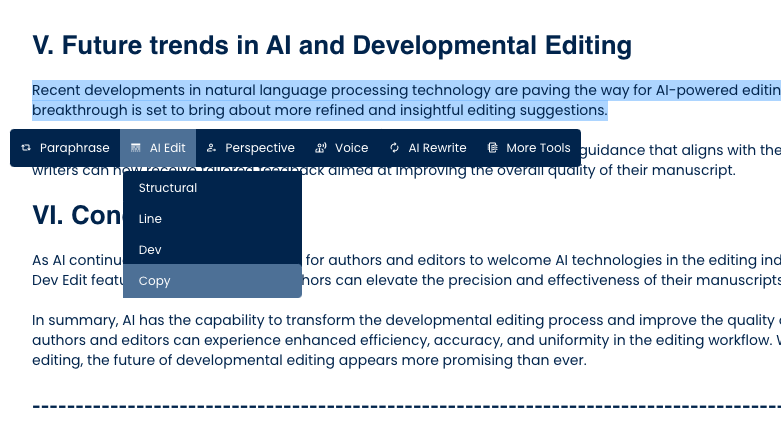
Use the mouse or keyboard controls to select the desired input content, then hover on “AI Edit” under more tools option.
What is the third step to finalize AI copy editing?
Choose “Copy” option and provide a prompt if you have any additional requirements.
Step 3
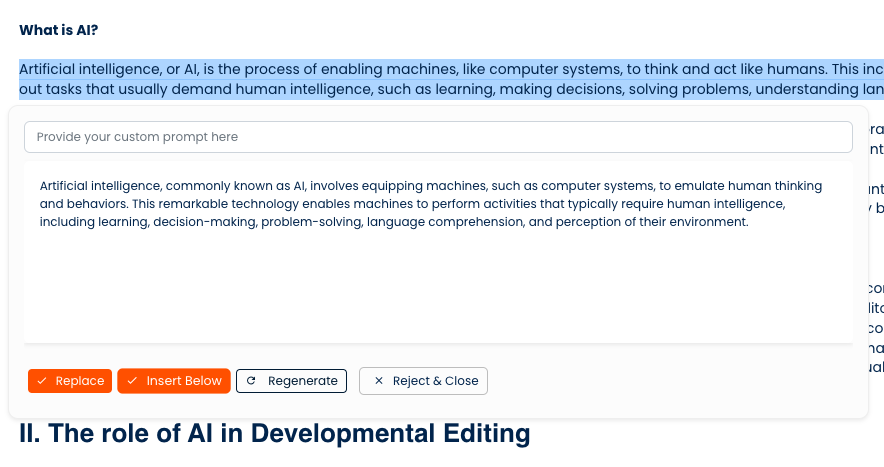
Proceed by clicking on “Replace” or “Insert Below” to get your desired content.