

I spent six years working on my first novel. Six years of scattered notebooks, half-finished Word docs, and a plot outline that contradicted itself by chapter four. My second novel took eleven weeks. The difference wasn’t talent or discipline — it was having the right AI book writer alongside me for the messy, stalling parts of the process.
That tool was Manuscripts.ai, and here’s what actually changed.
From Scattered Ideas to a Working Outline in One Sitting
Most writing advice tells you to outline first. Useful advice — but it skips the part where your ideas are a tangled pile of character sketches, half-formed scenes, and mood-board screenshots you saved at 2 a.m.
Manuscripts.ai’s Braindump tool is built for exactly that stage. You dump everything — raw character notes, scene fragments, thematic ideas, snippets of dialogue — and the AI organizes it into a structured chapter outline. Not a rigid template. A flexible skeleton you can rearrange, expand, or scrap entirely.
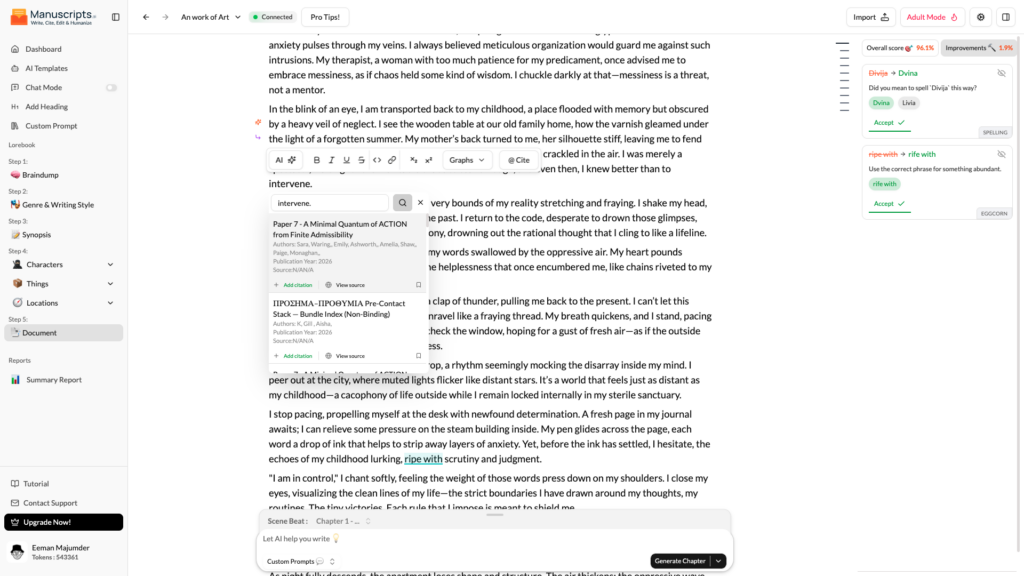
After Braindump, I used the Synopsis Generator to test whether my story actually held together as a narrative. It produced three different synopsis options from my outline — each emphasizing a different thematic angle. That forced me to decide what the book was really about before I’d written 30,000 words in the wrong direction.
Writing the Actual Chapters — How the AI Assists Without Taking Over
Here’s what most people misunderstand about AI novel writing: the AI doesn’t write your book. You write your book. The AI handles the parts that slow you down.
With Manuscripts.ai’s Scene Beats & Prose feature, I’d define the emotional arc of a chapter — what needs to happen, which characters are present, what shifts by the end — and the AI would generate a first-pass draft. Sometimes I kept 40% of it. Sometimes I kept a single paragraph and rewrote everything around it. Either way, I was never staring at a blank page.
For consistency across 85,000 words, the Lore Book Creator and Characters & Things module kept everything straight. My protagonist’s eye color didn’t mysteriously change in chapter nine. The geography of my fictional city stayed consistent. The timeline of events didn’t contradict itself.
The Tools That Actually Matter for Fiction Writers
Not every feature matters equally for every writer. If you’re writing a novel, here’s what I’d prioritize:
Braindump → For the pre-writing chaos stage. Get your ideas out of your head and into structure.
Synopsis Generator → Test your premise before committing to 200 pages.
Lore Book Creator → Essential for fantasy, sci-fi, or any book with worldbuilding. Centralized settings, timelines, and rules you can reference while writing.
Scene Beats & Prose → Chapter generation based on your beats. Keeps momentum going during drafting.
Complete Story → When you’re stuck mid-chapter and need to push through a difficult scene, this tool helps you finish it rather than abandoning the draft.
Expand Story → Takes thin scenes and develops them to their full potential. Useful during revision when your editor says “this scene needs more.”
Manuscripts.ai supports 15+ AI models — including OpenAI/GPT, Claude, Gemini, DeepSeek, and Meta/Llama — so you can choose the model that matches your writing style or switch between them for different tasks.
What About Editing?
Writing the draft is half the work. The other half is making it good.
Manuscripts.ai includes four distinct AI editing modes: Structural Edit (does the story work?), Developmental Edit (are characters and themes developed?), Copy Edit (grammar, punctuation, consistency), and Line Edit (sentence-level polish).
I ran my second novel through all four in sequence. The Structural Edit caught a subplot I’d abandoned without resolving. The Developmental Edit flagged a supporting character whose arc went nowhere. Copy Edit and Line Edit cleaned up the prose. The 40+ interactive reports — including an Adverbs Report and readability metrics — gave me hard data on where my writing was lazy.
Pricing That Doesn’t Punish Prolific Writers
A novel manuscript runs roughly 60,000–100,000 words. Here’s what that costs on Manuscripts.ai:
| Plan | Price | Words Included |
|---|---|---|
|
Free Trial |
$0 |
~10,000 words |
|
Professional Monthly |
$39.88/month |
~1,000,000 words |
|
Annual Professional |
$300/year |
~12,000,000 words/year |
One million words per month on the Professional plan. That’s ten full novels’ worth of AI-assisted output for under $40. If you need more, additional tokens are $10 per 200,000 tokens.
The free trial gives you roughly 10,000 words — enough to test Braindump, generate a synopsis, and draft a chapter or two. No credit card required.
Start your free trial — 10,000 words free, no credit card required
Who This Is Actually For
Manuscripts.ai’s AI book writer works best for:
- Novelists who have ideas but struggle with the blank-page-to-finished-draft pipeline
- Series writers who need consistency tools across multiple books
- Genre fiction authors (romance, thriller, fantasy, sci-fi) where Lore Book and character tracking shine
- Self-published authors who can’t afford a $3,000 developmental editor but still want professional feedback on structure
It’s not a magic button. You still need a story worth telling, characters worth caring about, and the willingness to revise. What it removes is the mechanical friction — the hours spent reorganizing notes, the days lost to blank-page paralysis, the structural problems you don’t catch until draft four.
If that friction is what’s standing between you and a finished manuscript, this is worth trying.