

What is the difference between the words ‘Among’ and ‘Amongst’?
Among and amongst are prepositions, both of which have very similar meanings, although there are very slight differences in use and form. The difference lies majorly in the formality and regional use.
1. Formality:
Among is more formal than amongst. Where among finds usage in both formal and informal conditions, latter is majorly used in formal situations.
-If one is to write an academic paper, a business report, or even a legal document, among should be preferred instead of amongst.
-Amongst does sound a bit archaic and wordy for spoken English, so in most informal conversations, one simply avoids using amongst.
2. Regional Usage:
Among is the preposition of choice in American English, whilst in British English, the regional usage would be amongst.
-Amongst, in British English, is used far more extensively to mean among in formal writing and literature. In American English, amongst seems archaic and redundant, so it is little used.
3. Etymology
Although amongst is certainly considered as the archaic form of among, nearly both words are derived from the same root. Amongst represents a blend of among and the Old English superlative suffix –st, whereas among is from Old English onmang.
-Both among and amongst have been around for hundreds of years, but among has slowly become the better choice for everyday conversation.
4. Clarity:
-From a clarity perspective, among is generally favored, as it’s simpler and clearer. Amongst sometimes may bring along ambiguity or even formality in certain contexts.
-Amongst is sometimes used for emphasis or just to formalize writing, primarily British English.
5. Phrasal Use:
-Amongst is much more usually used in fixed phrases, or idiomatic expressions. For example, “in amongst” seems to correspond to the meaning of “between” or even “surrounded by” in British English.
– Among is used much more frequently in prepositional phrasing, as in “among others” or “among the crowd.”
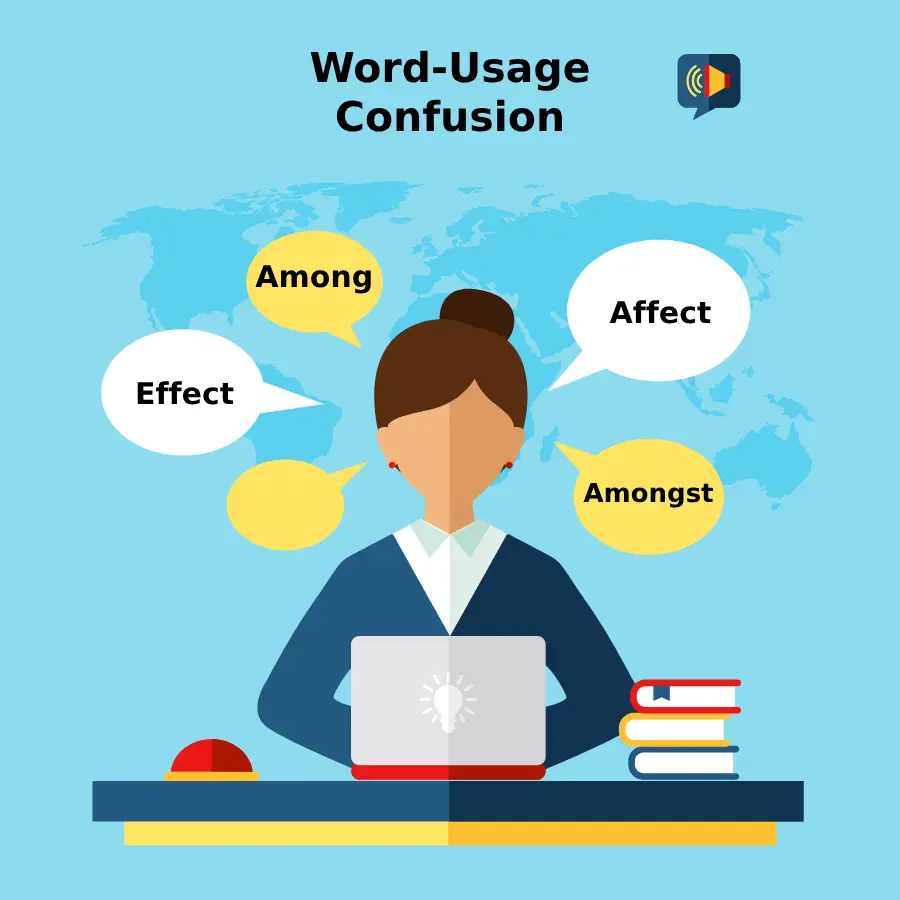
What are other confusing words to be aware of, such as 'Affect' and 'Effect'?
Other confusing words to be aware of include 'Affect' and 'Effect'. 'Affect' is primarily a verb meaning to influence or impact something, as in 'The weather affected my mood.' 'Effect' is mainly a noun referring to the consequence or outcome of an action, such as 'The new policies had a positive effect on the company’s profitability.' These words are often confused due to similar sounds and contexts, but their meanings and applications differ significantly. The text further elaborates on their usage, including 'affect' as a noun in psychology, and provides a mnemonic for easier recall.
Affect is a verb that means to influence or have an impact upon something. It refers to the act of bringing about change or difference in a situation. For instance, “The weather affected my mood,” or “The new policies will affect the profitability of the company.” In these sentences, affect is used to show how one thing influences another.
On the other hand, effect is a noun that means the consequence or outcome of something happening—a result from an action or event. For example, “The new policies had a positive effect on the company’s profitability,” or “The medication had a calming effect on the patient.” In both these examples, effectiveness is used to express or imply the consequence or outcome of some action or event.
You might find it easier to remember that “affect” is a verb, while “effect” is generally a noun, by using the mnemonic “Ravens Affect Eagles For Entertainment.”.
It is worth noting that “affect” can be used as a noun as well. In psychology, it refers to the mood of a person at any given time. In such contexts, affect refers to the externalised emotion, for instance, in a person, through facial expression or body language. For example, “The patient’s flat affect was an indication that he did not react emotionally to the situation.”
On the other hand, affect is a verb that means to influence or have an impact on something; effect, on the other hand, is a word for a result or outcome generally of an action or event. With this definition, you should be able to use these words effectively in writing and communication.
How Manuscripts can transform your academic writing in minutes ?
Are you tired of spending hours perfecting your academic essays? Do you struggle with finding the right words to convey your ideas effectively? Manuscripts.ai is here to revolutionize your writing process and help you transform your academic work in minutes.
With features like the Paraphrase tool, AI Edit, Rewrite, and Expand Content with AI, Manuscripts.ai takes your writing to the next level. The Paraphrase tool helps you rephrase sentences and paragraphs to avoid plagiarism and improve the flow of your writing. AI Edit provides suggestions for grammar and punctuation, helping you refine your work with ease. The Rewrite feature allows you to restructure your sentences for better clarity and coherence, while Expand Content with AI suggests additional information to enhance your arguments.
One of the most valuable features of Manuscripts.ai is the Opposing Arguments tool. This tool helps you anticipate and address counterarguments in your writing, strengthening your arguments and making your essays more persuasive. The Summary Generator tool helps you condense your ideas into a concise summary, perfect for introductions or conclusions. Translate, Generate Outline, and Generate Heading features assist you in organizing and translating your work, making the writing process more efficient.
Whether you need help writing an introduction, conclusion, or an opposing argument, Manuscripts.ai has you covered. The autocomplete assistant offers suggestions for completing your sentences, saving you time and energy. And with the Citation tool, you can easily generate citations in any format, ensuring your work is properly credited.
Manuscripts.ai is the ultimate AI essay writer for students who want to improve their academic writing quickly and effortlessly. With its advanced features and user-friendly interface, Manuscripts.ai is a game-changer for students looking to excel in their studies.
In conclusion, Manuscripts.ai can transform your academic writing in minutes, saving you time and helping you produce high-quality essays. Say goodbye to writer’s block and hello to efficient, effective writing with Manuscripts.ai – the future of academic writing.